
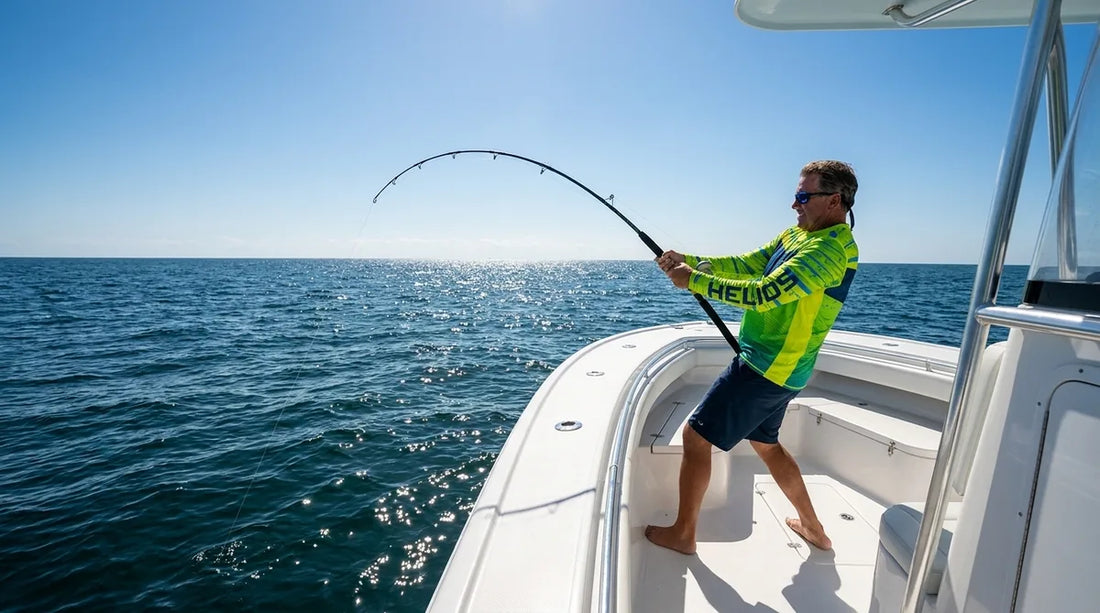
How to Fish Offshore All Day Without Getting Sunburned
Most offshore anglers know the sun is intense on open water. What they underestimate is how much more intense it is compared to inshore or freshwater fishing — and why the gear strategies that work on a shaded river bank don't translate to a full day on a blue-water charter.
This guide covers the specific UV dynamics of offshore fishing, what to wear for complete sun protection across an 8-to-12-hour day, and where most anglers go wrong.
Key Takeaways
- Offshore UV exposure is measurably higher than inshore — open ocean reflects 25% of UV radiation back upward, meaning you're getting hit from both above and below simultaneously
- Sunscreen alone is insufficient for a full offshore day — sweat, spray, and repeated hand-washing strip it within two hours, and most anglers don't reapply on schedule
- UPF 50+ clothing blocks 98% of UV rays and doesn't wear off — a long-sleeve UPF shirt does more reliable work over an 8-hour trip than any sunscreen regimen
- Coverage strategy matters as much as UPF rating — a shirt only protects what it covers; neck, face, and hands are the most commonly neglected areas
- Breathable UPF fabric runs cooler than bare skin in direct sun — the shade effect of fabric over skin reduces surface temperature even in tropical heat

Why Offshore Sun Exposure Is Its Own Category
Put an angler on a shaded stream bank and the sun is a partial-day problem. Move that same angler onto a sport fishing boat thirty miles offshore and the situation changes completely.
There is no shade on a center console or charter boat cockpit. No tree canopy, no dock overhang, no cloud cover most days. The boat is moving, which means the angles constantly shift — even a T-top only covers certain positions. And unlike a lake, the open ocean reflects UV radiation back at you from the surface. NOAA estimates ocean surfaces reflect 10–25% of UV upward. Combined with direct overhead sun, UV arrives from multiple angles simultaneously.
Then there's duration. A weekend lake trip might run four hours. An offshore charter regularly runs eight to twelve hours, departing before sunrise and running through the afternoon peak UV window (10 AM to 2 PM) with no option to step inside.
Offshore fishing produces higher cumulative UV exposure per trip than almost any other outdoor fishing context. Dermatologists routinely cite commercial fishermen and offshore recreational anglers among the highest-risk groups for UV-related skin damage.
Why Sunscreen Falls Short Offshore
The standard response — "just wear sunscreen" — is reasonable advice for a two-hour beach walk. It is not an adequate strategy for an eight-hour offshore trip, for several reasons.
Sweating degrades sunscreen faster than UV exposure does. On a hot day offshore, most anglers are sweating continuously within the first hour. SPF 50 sunscreen that's been sweated through is performing at a fraction of its rated protection. Real-world studies (not lab conditions) show that application-to-degradation time under physical exertion is closer to 60–90 minutes than the two-hour recommendation on the label.
Saltwater spray rinses off protection constantly. Fighting a fish, gaffing, handling bait — hands and forearms go in and out of water throughout the day. Every hand-wash after bait handling removes sunscreen from the forearms too.
Anglers don't reapply on schedule. In the middle of a tuna bite, no one pauses to reapply. Reapplication gets skipped precisely during the periods of highest activity — which are also the periods of most sustained sun exposure.
UPF 50+ clothing sidesteps all three problems. A fabric that blocks 98% of UV doesn't sweat off, doesn't rinse off, and works without any action on your part. That's the practical case for clothing as the primary layer offshore.
Our deep-dive on UPF 50+ vs. sunscreen for anglers covers the research behind that comparison.
What to Wear: Building a Complete Offshore Sun Coverage System
The goal is simple: cover as much skin as possible with UPF-rated fabric, then use sunscreen only for the gaps. Here's how to think through each area.
The Core Layer: Long-Sleeve UPF Shirt
This is the most important piece. A long-sleeve UPF 50+ shirt covers your torso and arms — the largest surface areas — continuously, without any maintenance or reapplication.
When selecting an offshore fishing shirt, prioritize:
UPF 50+ rating. This is the minimum that provides meaningful protection. Lower ratings let through proportionally more UV — a UPF 30 shirt lets through roughly 3.3% of UV versus 2% for UPF 50+. In an 8-hour offshore environment, that difference compounds.
Moisture-wicking, quick-dry construction. On a boat moving at 30 knots in 85-degree heat, a shirt that holds sweat becomes miserable within the first hour. The best offshore sun shirts are built from lightweight polyester that moves moisture away from skin and dries rapidly, keeping you cooler than you'd be without a shirt at all.
Odor resistance. An offshore trip means the shirt is doing hard work — sweat, saltwater, fish handling, sunscreen residue. A shirt with odor-resistant treatment remains wearable across a multi-day offshore trip without becoming unpleasant.
The Helios long-sleeve UPF 50+ fishing shirt hits these marks at $59.95 — lightweight at 4.2 oz/sq yard, moisture-wicking, quick-dry, and rated UPF 50+ across 100+ wash cycles. It's the kind of shirt that doesn't feel like sun protection gear; it just feels like a comfortable fishing shirt that happens to do a job sunscreen can't.
Neck and Face: The Most Neglected Coverage Area
The neck and lower face are consistently where offshore anglers show the most concentrated sun damage. The head-down position while fighting a fish, baiting hooks, or working the cockpit exposes the back of the neck to direct overhead sun for extended periods. A wide-brim hat covers the top of the head but leaves the neck exposed.
Two options work well here:
Hooded UPF shirt. A sun shirt with an integrated hood provides continuous neck and lower face coverage without the discomfort of a separate neck gaiter getting warm and damp. The hood moves with you, stays in position, and provides shade at angles where a hat brim doesn't reach. For anglers doing multi-hour offshore trips regularly, the Hooded Helios with integrated gaiter adds neck and face coverage built into the same garment — no separate piece to remember, no gap where the shirt collar ends and the hat begins.
Neck gaiter. A separate UPF 50+ neck gaiter is the more flexible option for anglers who run hot and want to pull coverage on and off as conditions change. Our UPF 50+ neck gaiter is a popular cross-sell for offshore anglers who already own a standard long-sleeve sun shirt — it pulls up over the nose and lower face when the sun is directly overhead and drops to the neck when you need airflow.
The mistake most offshore anglers make is treating the neck as a sunscreen zone rather than a fabric coverage zone. Sunscreen on the back of the neck during a full-day charter doesn't survive the day. Fabric does.

Hands: Where Anglers Accept Unnecessary Damage
Glove use is common in other water sports and almost nonexistent in offshore fishing, despite hands being among the most consistently UV-exposed body parts on a boat. UPF-rated fingerless or three-quarter fishing gloves cover the back-of-hand area while leaving fingers free for knot tying, lure rigging, and hook handling — a small addition with outsized impact on cumulative hand exposure over a season.
For the remaining exposed skin — face above the gaiter, ears, and the back of the hands if you skip gloves — a broad-spectrum SPF 50 mineral sunscreen applied before departure and reapplied every 90 minutes covers the gaps.
Hat: Type Matters
Not all hats protect equally offshore. A standard ball cap leaves ears, neck, and the sides of the face exposed. A wide-brim hat (minimum 3-inch brim) provides shade to ears, the back of the neck, and the sides of the face. For offshore use, look for hats with UPF-rated fabric rather than simply relying on shade — on reflective open water, UV arriving from the sides and below the brim matters.
The Offshore Angler's Pre-Trip Sun Prep Checklist
Run through this the night before or morning of your charter:
Clothing:
- Long-sleeve UPF 50+ shirt (washed, DWR or moisture-wicking properties intact)
- Hood or gaiter for neck/face coverage
- Wide-brim UPF hat
- Fingerless UPF fishing gloves (optional but recommended for full-day trips)
- Polarized sunglasses with UV400 protection (protects eyes and reduces reflective glare)
Sunscreen (for gap coverage):
- Broad-spectrum SPF 50+ mineral formula for face, ears, and exposed hands
- Travel-size bottle in tackle bag — plan for 90-minute reapplication timing
- Lip balm with SPF 30+
Timing:
- Apply sunscreen before departure, not on the boat
- First reapplication by 10 AM if you left before 8 AM
- Reapply after any significant water contact (gaffing, fishing overboard for something dropped)
Professional guides — who fish 200+ days per year — can't afford to rely on sunscreen compliance. Our breakdown of why fishing guides wear hooded sun shirts explains how the offshore professional world approaches this problem, and why clothing leads.
What to Look for in an Offshore Sun Shirt
Offshore fishing puts specific demands on sun shirts that inshore or freshwater use doesn't. Three things to evaluate beyond the UPF rating:
Color. Lighter colors (white, glacial, light blue) absorb less heat than dark colors, which matters when you're wearing the shirt for 10 hours in tropical conditions. Both work at UPF 50+ ratings, but heat management favors lighter fabric on open water in summer.
Weight and construction. Offshore anglers who haven't worn a modern UPF shirt often assume covering up means getting hotter. A well-constructed 4-ounce polyester UPF shirt in direct sun runs cooler than bare skin because fabric provides shade that reduces surface heat absorption even while allowing airflow. A cotton long-sleeve shirt in offshore heat is miserable. A technical fishing shirt is not.
Durability through washing. UPF ratings are tested on new fabric. Some cheaper shirts lose significant protection after repeated washing as the weave structure relaxes. For offshore anglers washing salt out of shirts after every trip, look for shirts rated UPF 50+ through 50+ wash cycles. The Helios line maintains its rating through 100+ wash cycles.
For a comprehensive look at how different brands compare, our guide to the best long-sleeve fishing shirts for sun protection puts several options side by side.
Two Mistakes That Burn Offshore Anglers
Ignoring reflected UV. Anglers who fish inshore in mangroves or shaded river sections are accustomed to overhead UV as the primary threat. Offshore, reflected UV off open water hits from below your hat brim and from the sides simultaneously. Polarized sunglasses and a wide-brim hat matter more offshore than in shaded freshwater — and sunscreen needs to cover the lower face and neck that hat brims don't shade.
Skipping protection on overcast days. Cloud cover reduces visible light but not UV. Up to 80% of UV passes through cloud cover. An overcast offshore day with comfortable temperatures is exactly when anglers skip sun protection — and often the day they come home burned from the reflection off the water below them. The UV index on an overcast day offshore is still meaningfully high, and cumulative exposure over eight hours adds up regardless of whether you felt the sun directly.

Building the Habit: How Offshore Regulars Approach It
Anglers who fish offshore regularly converge on the same system: a dedicated sun kit that goes with them every time, not something assembled freshly each trip. The kit lives in a bag that gets loaded onto every charter: shirt, gaiter or hooded shirt, hat, gloves, backup sunscreen. Pack it the night before — the angler assembling sun gear at the dock while everyone else is rigging lines is the one who forgets half of it.
Browse the full sun protection collection to build out a complete offshore kit — most offshore regulars end up with a two-shirt rotation so one is always clean and dry when they need it.
FAQ
Does wearing a dark-colored UPF shirt make me hotter offshore?
Lighter colors absorb less heat, which matters on a 10-hour summer trip. But the bigger factor is construction — a 4-ounce moisture-wicking polyester shirt in any color runs cooler than a cotton shirt, and cooler than going shirtless in direct sun. Dark colors are popular offshore because they hide bloodstains and spray, and the heat difference with quality technical fabric is minimal in moving air.
Can I just use a UPF rashguard instead of a fishing shirt?
A rashguard provides equivalent UV protection if it's rated UPF 50+. The practical difference is feature set: fishing shirts include vents, utility pockets, and collar designs suited to wearing with a gaiter or hood. Rashguards work fine, but they're designed for water use rather than 10-hour fishing days. If fishing-specific features don't matter to you, a UPF rashguard is a valid alternative.
How do I know when my UPF shirt needs to be replaced?
Replace it based on physical wear: fabric thinning at elbow creases, significant fading, holes or tears — all reduce UV protection. A shirt maintained through proper washing (cold water, no bleach, low heat or air dry) maintains its UPF rating for several years. Replace on structural wear, not a calendar schedule.
What SPF should I use for areas sunscreen still needs to cover offshore?
SPF 50 broad-spectrum mineral sunscreen (zinc oxide or titanium dioxide) for face, ears, and the back of hands. Mineral formulas hold up better under sweat and spray than chemical formulas. Apply before departure, reapply every 90 minutes, carry a backup in your tackle bag.
Does the UV index actually vary offshore versus onshore?
The UV index is based on overhead solar radiation — essentially the same offshore as on land at the same latitude. What changes offshore is the reflected component: open ocean reflects 10–25% of UV back upward, adding to total exposure. A UV index of 9 offshore produces measurably more total UV than the same index on a city street because of that reflected component.