
Budget Fishing Shirts Comparison: Helios Destroys Magellan - Premium Performance at Budget Price
If you're weighing a Helios fishing shirt against a budget option like Magellan, the decision comes down to three things you can actually verify: the certified UPF rating, how the fabric is constructed, and how long you get to test the shirt before you're stuck with it. Helios is a UPF 50+ shirt sold direct-to-consumer with a 99-day money-back guarantee. Magellan is Academy Sports' house brand, priced lower and available in stores. This guide explains what separates the two on the specs you can check yourself — and what to look for so you don't buy a shirt that stops protecting you halfway through the season.
When choosing from our shop all sun protection, you'll find the best quality and selection.

Key Takeaways
- UPF 50+ is a certified rating, not a marketing word — it means the fabric blocks 98% of UV. Check for the number, not the phrase "sun protective"
- How the UV protection is built matters: protection woven into the fiber structure survives washing; surface treatments wash out over time
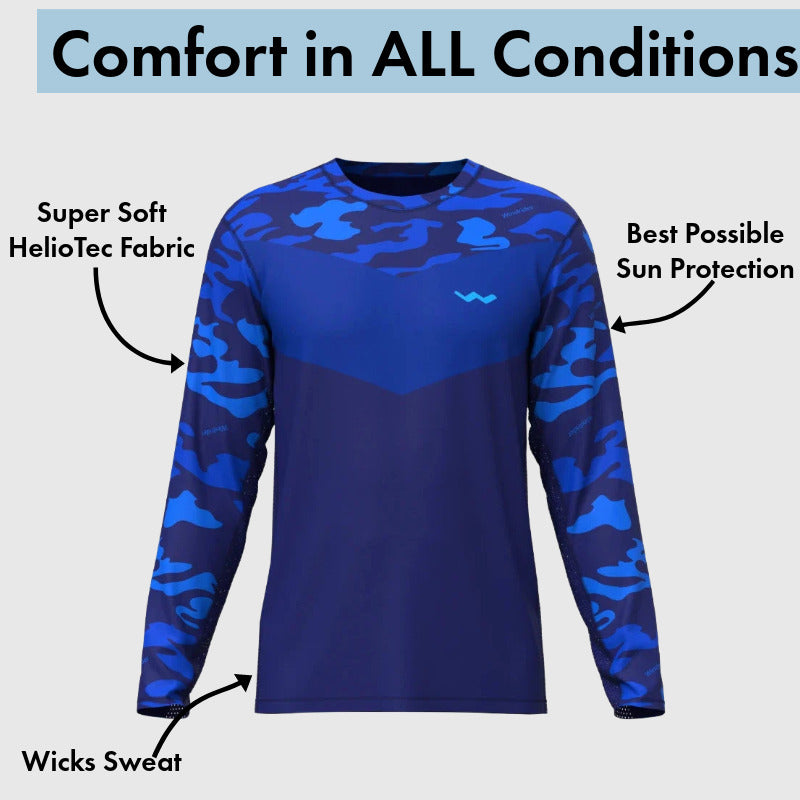
- Helios is UPF 50+, lightweight, quick-drying and odor-resistant, sold direct so you're not paying retail markup
- A budget shirt that needs replacing every season isn't cheaper than one that doesn't — but you need real use to know which you bought
- The 99-day money-back guarantee exists so you can find that out on the water, at no risk
Why Does Magellan Cost Less Than Helios?
Magellan Outdoors is Academy Sports + Outdoors' in-house brand. House brands are priced lower for structural reasons that have nothing to do with any individual shirt: the retailer owns the label, buys in large volume, and doesn't pay a third-party brand's margin. That's a genuine advantage for the shopper on price.
Helios reaches you a different way. WindRider sells direct, with no retail middle layer, which is why a UPF 50+ shirt with our construction lands in the price range it does rather than the specialty-brand range. Both models cut cost — they just cut it in different places.
What that means practically: price alone won't tell you which shirt protects you better. Two shirts at very different prices can carry the same certified UPF 50+ rating, and two shirts at the same price can be built completely differently. The spec sheet and your own use are what settle it.
What Actually Separates Fishing Shirts
Here's what's worth checking before you buy anything, at any price:
The certified UPF number. UPF 50+ means the fabric blocks 98% of UV radiation — only 1/50th passes through. UPF 30 blocks about 97%. Both are real protection; UPF 50+ is the level the Skin Cancer Foundation classifies as excellent. A shirt that says "sun protective" without a number hasn't told you anything.
How the protection is built in. This is the difference that shows up in year two. UV blocking that comes from the fabric's own tight synthetic weave and fiber structure doesn't wash out. Protection applied as a surface finish is a coating, and coatings wear. Helios UPF 50+ protection is structural to the fabric.
Fabric weight and dry time. A lighter fabric that moves moisture and dries quickly keeps you cooler than a heavier one that stays damp. Helios uses a lightweight, quick-dry, moisture-wicking polyester with odor resistance built in.
Seam and stress-point construction. Shoulder seams, cuffs, and pocket attachments are where fishing shirts fail first, because that's where casting, netting, and reaching load the garment. Look at how those points are finished.
How Does Helios Handle Heat and Moisture?
The job a sun shirt does in the heat is counterintuitive: covering up keeps you cooler than exposing skin, as long as the fabric is doing its part. Bare skin in direct sun absorbs radiation as heat. A lightweight technical fabric blocks that radiation and simultaneously uses your own sweat to cool you as it evaporates.
Helios fabric is engineered for that cycle. It's moisture-wicking, so perspiration is pulled off the skin and spread across the fabric surface where it can evaporate rather than pooling. It's quick-dry, so a splash, a rain squall, or a hard-working hour doesn't leave you in a wet shirt for the rest of the afternoon. And it's lightweight and breathable, so air moves through it.
Where cheaper synthetic shirts tend to struggle is the saturation point. A fabric with minimal moisture transfer holds sweat instead of moving it, and once it's soaked, wet fabric clinging to skin actively works against cooling. This is a design characteristic, not a brand insult — it's what you're checking for when you compare fabrics.
Anglers who fish long days in heat consistently report the same thing in our reviews: the shirt they keep reaching for is the one that stops feeling like a wet shirt fastest.
What to Look For in Moisture Management
Read the fabric description, not the marketing headline. "Moisture-wicking" appears on nearly every fishing shirt sold, so the word alone doesn't differentiate. What differentiates is whether the fabric is engineered to move moisture across a surface area for evaporation, or simply absorbs it.
The practical test is one you can run yourself in the first week: get the shirt wet, then note how long before it stops feeling damp against your skin. A well-engineered quick-dry fabric handles this in minutes. If you're still clammy long after you've stopped exerting, the fabric isn't doing the job regardless of what the tag says.
Breathability is the companion property. A fabric can wick well and still trap heat if there's no airflow through the weave. Lightweight construction handles both at once, which is why fabric weight is worth asking about.
The reason this matters more on a long day than a short one is cumulative. An hour of mild discomfort is nothing. Eight hours of it changes how long you stay out and how well you fish.
What About UV Protection Over Time?
This is the part of a sun shirt purchase that's genuinely hard for a buyer to evaluate, because you can't see it. A shirt that's lost UV protection looks identical to one that hasn't.
Helios UV blocking is part of the fabric structure rather than a treatment applied on top of it. There's nothing to wash off. That's the specific reason we build it that way.
Shirts that get their rating from a surface finish behave differently over time. The finish is doing the work, and finishes degrade with washing, sun exposure, and abrasion. The rating on the tag was measured on new fabric — it's accurate the day you buy it, and it describes a starting point rather than a permanent state.
Because the change is invisible, the practical advice is the same regardless of brand: if a UPF garment has gone visibly thin, faded, or you can see light clearly through the weave when you hold it up, its protection has dropped and it's time to replace it. Don't assume a rating printed on a tag three seasons ago still describes the shirt you're wearing.
Why Sun Protection Is Worth Getting Right
The Skin Cancer Foundation recommends UPF-rated clothing as a frontline sun protection measure precisely because it doesn't depend on your behavior. Sunscreen has to be applied correctly, in sufficient quantity, and reapplied — and studies of real-world use consistently find people apply less than the tested amount and reapply less often than directed.
A shirt doesn't have that failure mode. It covers what it covers, all day, without reapplication, and it doesn't sweat off or wash off when you land a fish.
That's the honest argument for spending on sun protection: not a specific health outcome anyone can promise you, but the removal of the biggest weak point in sun protection, which is human consistency over an eight-hour day.
For anglers who fish frequently, the arms, neck and hands take the highest cumulative exposure. Those are exactly the areas a long-sleeve UPF shirt covers without you having to think about it again.
How Do Construction and Durability Compare?
Construction is where price differences usually become visible, and it's the one thing you can inspect directly before or right after buying.
Turn the shirt inside out and look at the seams. Flatlock seams lie flat against skin and resist chafing on long days. Reinforced or bartacked stress points at the shoulder and pocket attachments hold up to the repeated loading that casting and netting create. Single-line stitching at a high-stress point is where a shirt will eventually let go.
Fabric weight plays into durability as well as comfort, and it's a genuine trade-off rather than a case of more being better. Heavier fabric resists abrasion and pilling; lighter fabric breathes and dries faster. Helios is built on the light end deliberately, because for a sun shirt worn in heat, breathability and dry time are what you feel every hour.
The durability question that actually matters to your wallet is simple: how many seasons does the shirt stay in rotation? That's not something any spec sheet can tell you, and it's not something a brand can honestly promise. It's what the guarantee window is for.
Stress Points and Where Shirts Fail
Fishing shirts fail in predictable places. Shoulder seams take the load from casting and from hauling. Cuffs and thumbholes take abrasion. Pocket attachments take weight and get snagged. Hems fray where they rub against gear or a gunwale.
Helios reinforces the shoulder construction because that's the highest-load area on a fishing-specific garment, and flatlock seams throughout reduce the friction that eventually breaks stitching down.
Browse our waterproof rain gear for more options.
Pocket security is worth a specific look on any shirt you're considering, since a pocket that separates is how gear ends up in the water. Check whether the attachment is reinforced or simply stitched.
Fabric thinning is the last failure mode, and the one tied directly to protection. A shirt that's gone thin and translucent at the shoulders has lost both durability and UV blocking at the same time, which is a good reason to inspect rather than assume.
What Do Real Anglers Say About Helios?
We publish customer reviews rather than manufacture them, so the most useful thing we can tell you is what the review corpus actually shows across the sun protection line.
Across 5,019 published customer reviews of WindRider sun protection products, 93.7% rate their purchase 4 or 5 stars, with 86.7% at 5 stars. Those are our own verified-purchase reviews, not a survey or a testing panel.
The themes anglers raise most often, ranked by how frequently they come up: fit and sizing is the single most-discussed topic, followed by durability — customers want to know it will last — then neck and face protection, then whether the shirt looks good enough to wear off the water, and then sunburn protection itself.
Fishing is the dominant use case in those reviews, but it's not the only one. Boating, running, travel, beach and swimming, cycling, and outdoor work all show up in significant numbers, which tells you the shirt gets worn well beyond the days it was bought for.
It's also worth reading the critical reviews, not just the positive ones. Roughly 6% of reviews are 3 stars or below, and sizing is the most common reason. That's why we point people to the size chart before they order rather than after.
What the Review Data Actually Says
Aggregate review data is more useful than individual quotes because it's harder to cherry-pick. Here's what the sun protection corpus shows.
Fit is the number one topic by a wide margin — mentioned in more reviews than any other subject. That's a signal to order carefully, not a signal that the shirt fits badly; it reflects that fit is what people notice and comment on first with any apparel purchase.
Durability is the second most-discussed concern. Customers buying sun protection are explicitly thinking about whether it lasts, which is consistent with the wash-durability question this article opened with.
Neck and face coverage comes up in hundreds of reviews specifically — customers seek out the hood-and-gaiter combination rather than stumbling into it. That's the clearest product-selection signal in the whole dataset.
How Should You Think About Cost?
Cost-per-wear is the right frame for apparel, but it only works if you're honest that the inputs are estimates. Nobody knows in advance how many days a specific shirt will last for a specific person fishing in specific conditions.
What you can reason about is the shape of the math. A shirt's real cost is its price divided by the number of days you actually wear it. A less expensive shirt replaced often can end up costing more than a more expensive shirt that stays in rotation — or it can end up costing less, if it lasts fine for how you fish. Someone who fishes six days a year and someone who fishes six days a week will reach opposite conclusions from the same two shirts.
The variable that quietly matters most isn't durability at all — it's whether you wear the thing. A shirt that's too hot, too heavy, or uncomfortable enough that it stays in the closet has an infinite cost per wear and provides zero protection. Comfort is a protection feature.
Which is why the practical recommendation is to buy the shirt you'll actually reach for on a hot morning, and to buy it somewhere you can return it if you're wrong.
The Costs People Forget
A couple of secondary costs are worth factoring in, without overstating them.
Sunscreen is the obvious one. A long-sleeve UPF shirt covers your arms and torso, which is most of the surface area you'd otherwise be applying and reapplying to across a full day. You'll still need sunscreen for face, ears, neck if uncovered, and hands — but on a much smaller area, less often.
Time is the other. Applying and reapplying sunscreen properly across a full fishing day takes real minutes, repeatedly, usually at inconvenient moments. Clothing-based protection is a one-time decision you make when you get dressed.
Neither of these makes a shirt free. They're just real line items that a straight price comparison leaves out.
TL;DR Answers
- Check for a certified UPF 50+ rating — it means 98% of UV blocked. "Sun protective" without a number tells you nothing
- How the UV protection is built matters more than the initial rating: structural protection survives washing, surface treatments wear
- Helios is UPF 50+, lightweight, quick-dry, and odor-resistant
- Magellan is Academy's house brand — lower price, in-store availability. Compare on certified specs and construction, not on price alone
- Across 5,019 customer reviews of WindRider sun gear, 93.7% are 4-5 stars; fit and durability are what customers discuss most
Frequently Asked Questions

Is Helios worth more than a house-brand shirt?
It depends on how much you fish. If you're on the water regularly in strong sun, a UPF 50+ shirt in a lightweight quick-dry fabric you'll actually wear all day earns its price over a couple of seasons. If you fish a handful of days a year in mild conditions, a less expensive shirt may serve you fine. The 99-day guarantee is there so you can decide with the shirt in hand.
How can I tell when a UPF shirt has lost its protection?
You can't detect it precisely by eye, which is the honest answer. What you can do is inspect: hold the fabric up to light and look at how much passes through the weave, and check the high-wear areas at the shoulders for thinning or fading. Visible thinning, translucency, or heavy fading all indicate the fabric is no longer performing as it did new.
Will a Helios shirt last multiple seasons?
That depends entirely on how hard you use it and how you care for it. What we can tell you specifically is that the UPF 50+ rating is structural to the fabric, and that durability is the second most-discussed topic across our 5,019 sun protection reviews. We won't put a season count on it, because it would be a number we made up.
Does a lighter fabric really make a difference?
On a hot day, yes — noticeably. Lighter fabric breathes better, dries faster after a splash or a sweat, and carries less weight on your shoulders across a long day. On a mild day or a short trip you're unlikely to care. The heavier the heat and the longer the day, the more it matters.
Can I just buy several cheap shirts instead of one good one?
You can, and for some people that's a reasonable strategy — rotation extends the life of every shirt in the set. The thing to watch is that you're rotating shirts that still protect. Several shirts that have each lost their UV blocking don't add up to one that hasn't.
What if I fish infrequently — do I need UPF 50+?
UV exposure doesn't scale with how seriously you fish. A casual angler on the water at midday in July is getting the same intensity as anyone else out there. If you're spending hours in direct sun, covered skin is covered skin regardless of how many days a year you do it.
Are there situations where a budget shirt is the better call?
Yes. If you need a shirt today and there's an Academy nearby, in-store availability is a real advantage that a direct-to-consumer brand can't match. If you're buying a spare to keep in the truck, or something you expect to abuse and discard, price-first is a defensible choice. Buy the shirt that fits the job.
How do I know these claims are accurate?
Every performance claim in this article about Helios is either a certified fabric rating (UPF 50+ blocks 98% of UV), a published product specification, or aggregate data from our own customer reviews — and we've said which is which. We don't publish comparative test results we haven't run. The 99-day money-back guarantee lets you verify the shirt against your own expectations, on the water, and return it if it falls short.
Buy the Shirt You'll Actually Wear
The best sun protection is the shirt that's comfortable enough that you put it on without thinking about it. Helios is built around that idea: UPF 50+ protection that's part of the fabric rather than sprayed on it, in a lightweight quick-dry construction meant for long days in heat.
Every Helios shirt includes a 99-day money-back guarantee. Fish in it. Wash it. Compare it directly against whatever's currently in your closet. If it doesn't earn its place, send it back for a full refund.
That guarantee is the part of this comparison we can state without qualification — it's a policy, not a performance claim, and it puts the risk on us instead of you.
Start here:
- Hooded Helios with Gaiter - Full neck and face coverage in one piece
- Helios Long Sleeve Sun Shirt - The everyday UPF 50+ workhorse
Order your Helios fishing shirt, put it through a real season, and judge it on what it does rather than what anyone claims about it.
Shop our complete shop all ice gear today!